Hey, I'm

ABDUL WARITH SALMANABDUL WARITH SALMANABDUL WARITH SALMANABDUL WARITH SALMAN

I build revenue pipeline for MarTech companies that target ecommerce, D2C and consumer brands.

Which means I already spend every day emailing the exact buyer you are trying to sell to. I know what gets answered by that person, because I do it at volume and measure what comes back.

Get a free GTM plan → See the work

Your website and your offer in, a written plan back inside 24 hours. No call needed to get it.

20+clients closed in a quarter
147sales calls booked in a month
14,494brands reached in 60 days
1 in 3positive replies become meetings

Why me specifically

Your buyer is my buyer.

A generalist has to learn your market on your budget. Ecommerce and consumer brands are the only market I work in, so I arrive already knowing the verticals, the price bands, the seasonality and the objections.

The market

Ecommerce, D2C, consumer

Beauty, supplements, food and beverage, apparel, home. The brands your platform exists to serve.

What I know about them

Which ones can actually buy

Catalogue size, price band, whether they already sell on the channel. I qualify on evidence, not on a job title.

What that saves you

The first six months

No learning curve on your dime, and no campaign burning your domain while someone works out who to talk to.

Case study 01 · live

20+ clients closed in a quarter, from an outbound function I own end to end.

Blazi AI sells a creator-commerce service to consumer brands. I run sourcing, qualification, copy, sending infrastructure and the feedback loop. The founder takes the calls. Everything that reaches him came out of the system.
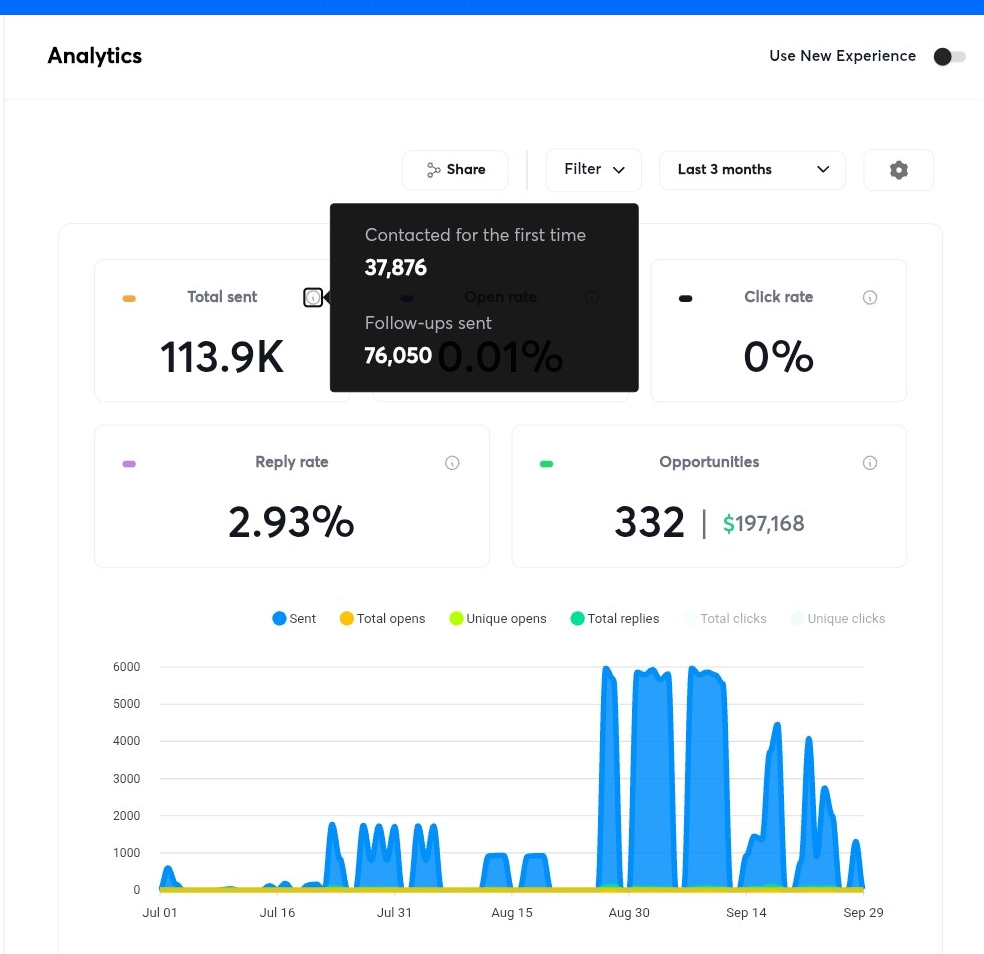
Sending platform analytics: 113.9K sent, 2.93% reply rate, 332 opportunities worth $197,168
The live account. 113.9K sent, 2.93% reply rate, 332 opportunities worth $197,168.
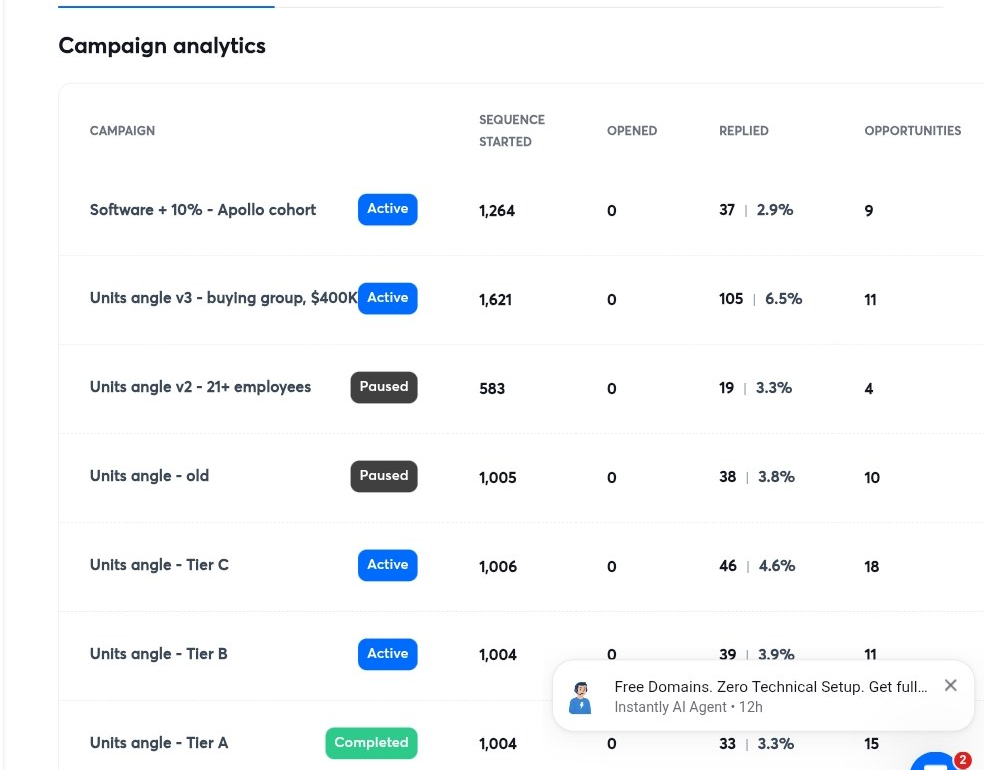
Per-campaign reply rates showing the tested angles side by side
The test log. Every angle running side by side with its own reply rate. The buying-group angle at 6.5% against 2.9% for the control is why it got the volume.

The offer came before the copy.

Nobody replies to a service description. The offer had to be something a brand could say yes to without a meeting, so it was built around a number they already care about: units of their own product, moved in a stated window, with the risk carried on our side rather than theirs.

Only once that was settled did the writing start. An offer that needs clever copy to survive is not finished.

The emails sell an outcome, never a process.

The words service, management, concierge and agency appear nowhere. The channel itself is barely mentioned. Every email arrives with one specific product of theirs already chosen, and a number attached to it.
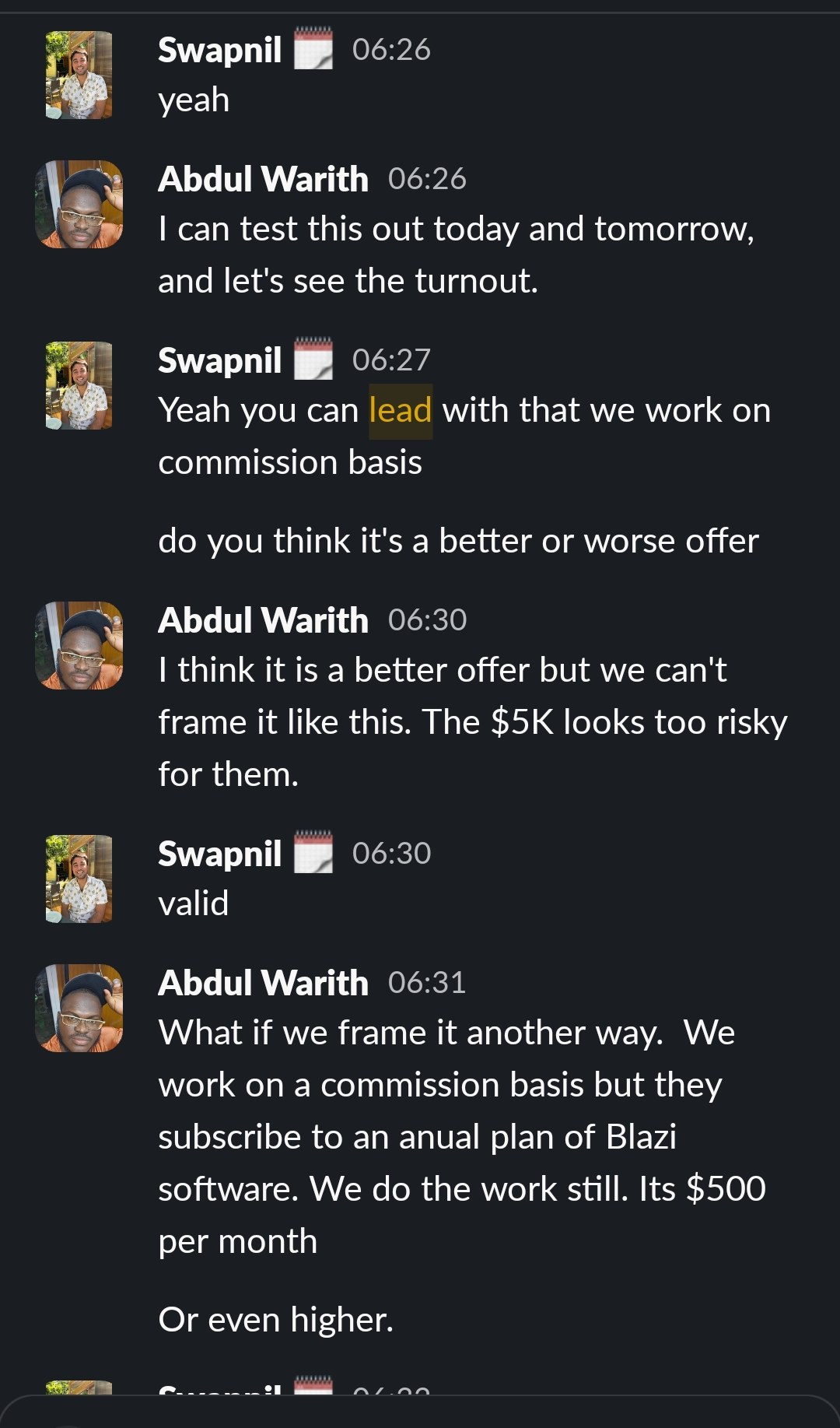
Thread diagnosing a stalled segment as a structure problem
When a segment stalls, the offer changes, not the subject line. This one was losing people on the structure of the fee rather than its size.

What came back.

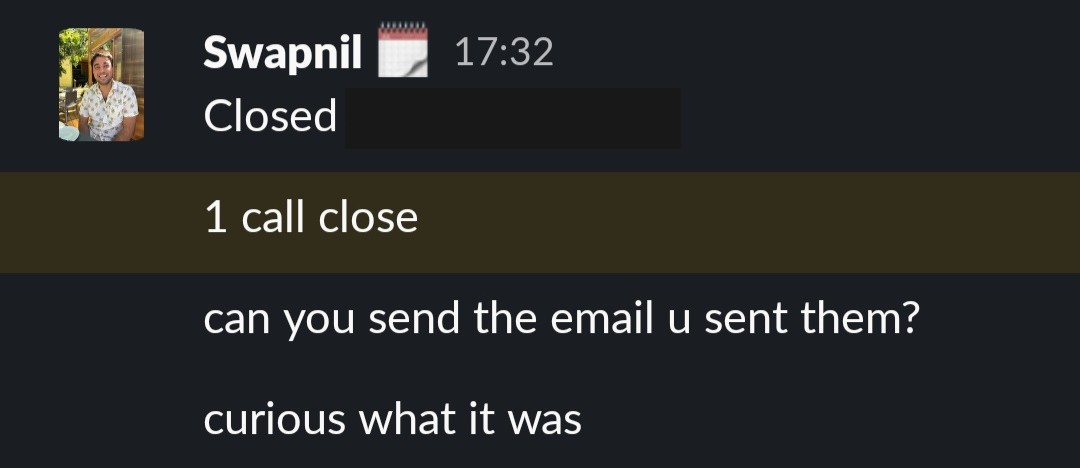
Founder message: closed a brand on one call, asking which email was sent
A one-call close, and the founder asking which email did it. That question is the review I care about most. client name redacted
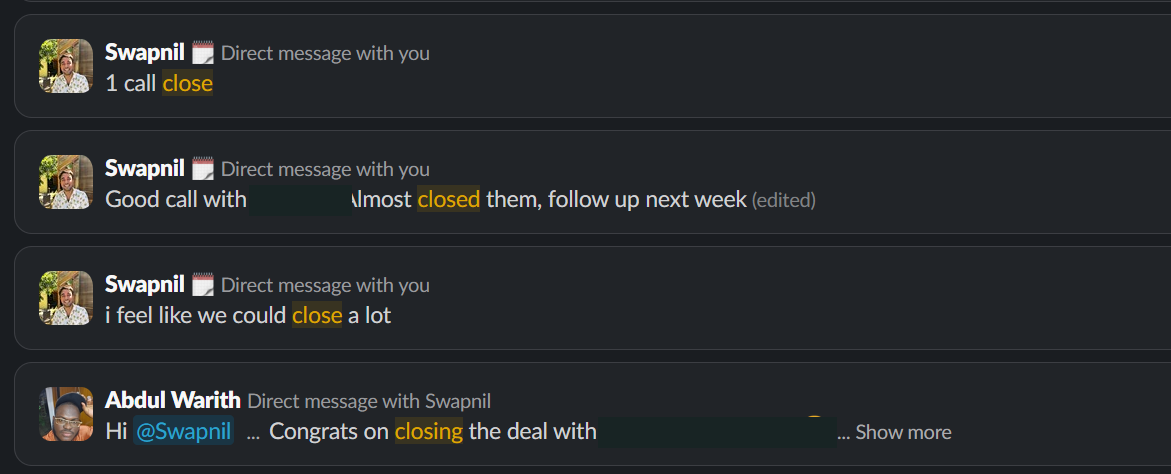
Several founder messages reporting closes in sequence
Not a one-off. Four messages in the same stretch: a one-call close, another nearly closed, a deal confirmed, and "i feel like we could close a lot". client names redacted
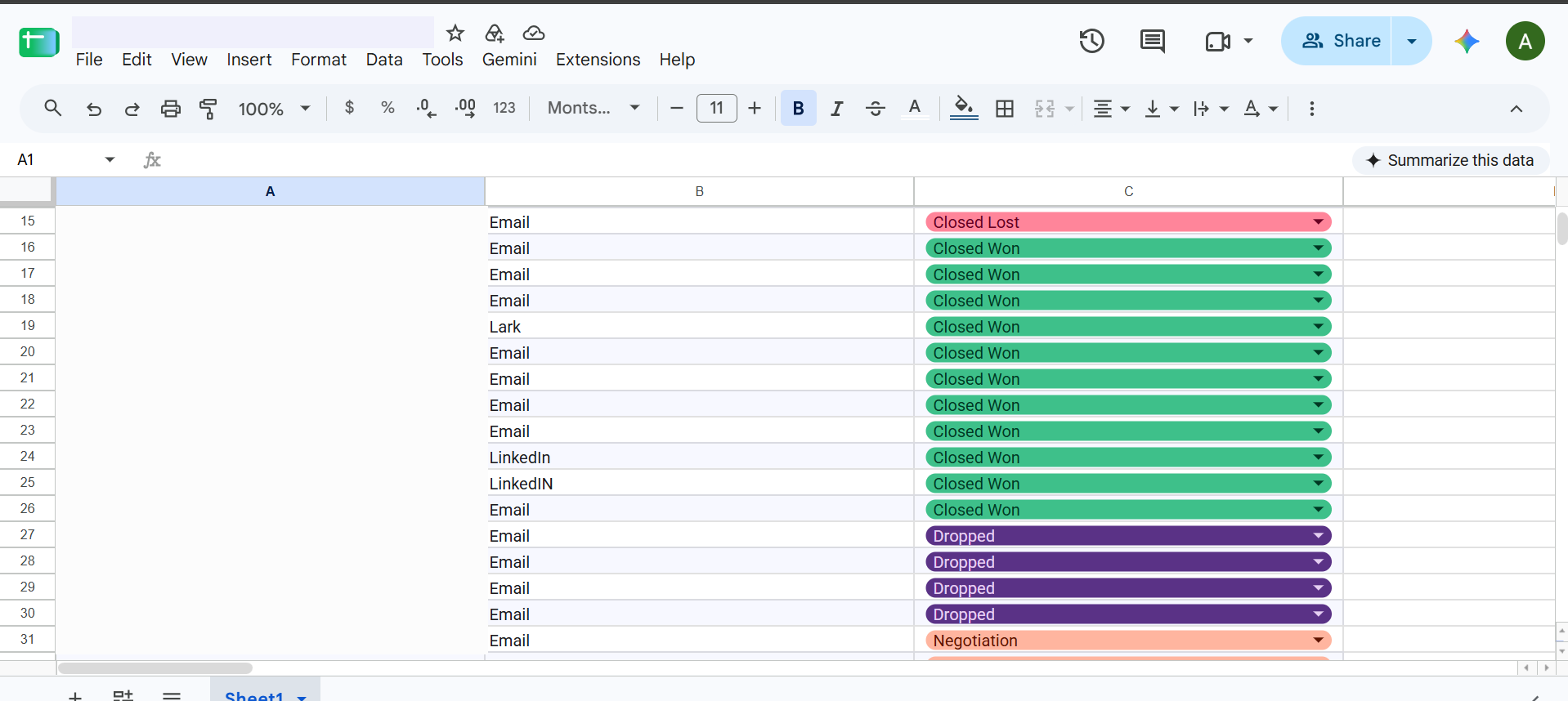
Client tracker showing channel and stage per account, names removed
The scoreboard. Nine Closed Won on this screen alone, plus the ones that closed and later churned, and one in negotiation. The channel column is the part worth reading: almost all of it is email. client names redacted

And when the numbers lied.

The CRM reported 277 brands as positive. I reconciled the tagging against the raw mail server and found 1,147 had actually replied. Three quarters of the inbound was invisible, which is how one real buyer sat unanswered for 34 days.

Early-stage reporting is usually wrong in a direction nobody checks. Finding that is the job as much as sending is.
How it works

End to end, and built to run without me.

Every stage is a separate step your team can run, re-run and inspect. That is deliberate. I build these to survive my leaving, not to make myself the dependency.

Source and resolve

Pull the addressable market from several providers, resolve each company to a real domain, confidence-scored.

Pre-qualify on evidence

Scrape every site and catalogue. Vertical, product type, whether the price sits in the band where units actually move. Most of a list does not deserve an email.

ICP scoring

Each surviving company scored and assigned a lane, with the reason written down so it can be argued with later.

Per-lead copy

Written from that company's own data, with the copy rules enforced in code so a bad line cannot reach a prospect because somebody was in a hurry.

Send and protect

Separate warmed domains, never the client's root. Reply monitoring on a seven-minute loop, inbox health checked daily, both as durable scheduled jobs.

Stage management

One lead in one stage at a time, with an owner, a next action and a date. Nothing lives in anyone's head.

Automated pre-call briefs

Before any call the closer gets the brand, their shop state, the product chosen, what we said and what was offered. He walks in knowing exactly what was promised in his name and does no research.

Post-call feedback loop

What happened on the call goes back into targeting. The campaign gets better because of the calls, not in spite of them.

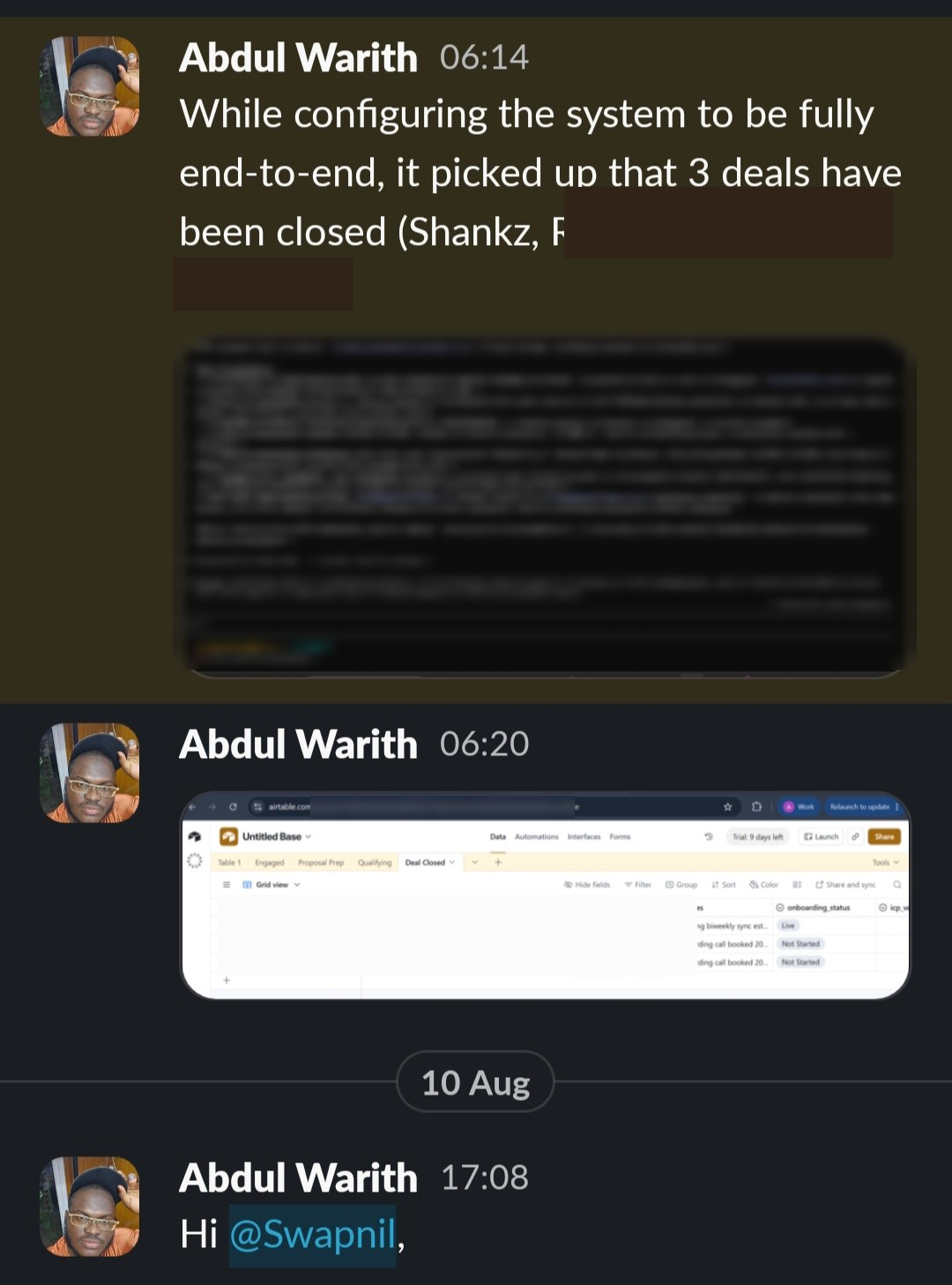
Lifecycle automation surfacing closed deals into a stage table
The lifecycle running. The automation surfaced three closed deals nobody had recorded yet, and wrote them into the stage table itself. client names redacted
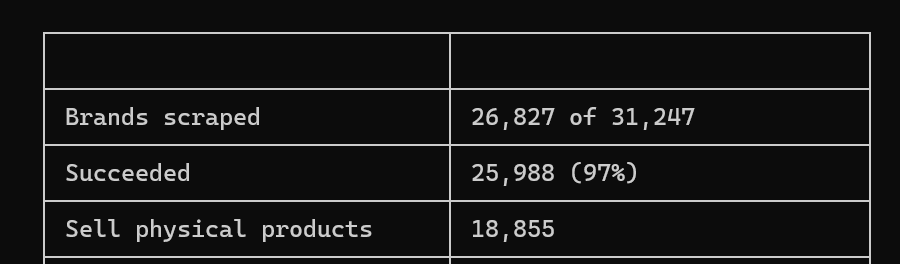
Scrape run: 26,827 of 31,247 brands, 97% success
Qualification at volume. 26,827 of 31,247 brands read, 97% success, 18,855 confirmed as selling a physical product. The rest were filtered out before anyone wrote a word.
50brands reached
→
1positive reply
→
1 in 3positives become a meeting

Both ratios reconciled against the sending platform and the raw mail records, not taken off a dashboard.

Case study 02 · the transfer test

Then I pointed the same system at a different market.

Revenue Landscape sells free-trial conversion to B2B SaaS. Not consumer brands, not creator commerce. The point was to find out whether the engine was specific to one vertical or actually transferable.

~6,000prospects, one month
301replies
97positive
60calls booked

The personalisation was the product.

For every company the system resolved the pricing page, scraped it, and had a model read the tier structure. It then scored them on it and looked for the gap in their own pricing that was suppressing signups.

A product with a 14-day trial and no free tier has a different problem from a freemium one, so it got a different argument. The email named that company's specific conversion leak.

Recipient reply praising the outreach as detailed and on point
From a recipient, unprompted. A senior product marketing manager at a prospect, replying to a cold email. recipient and company redacted
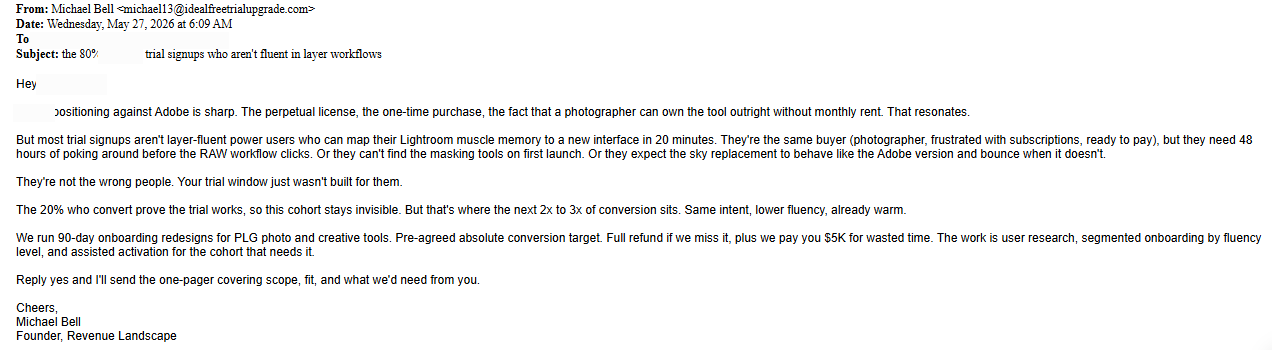
The cold email that earned the reply, arguing from the prospect's own trial structure
The email that earned it. It names their positioning, the specific cohort failing to activate, the size of the opportunity, and an offer with the risk on our side. No service description anywhere. prospect redacted

Scored, staged and tracked.

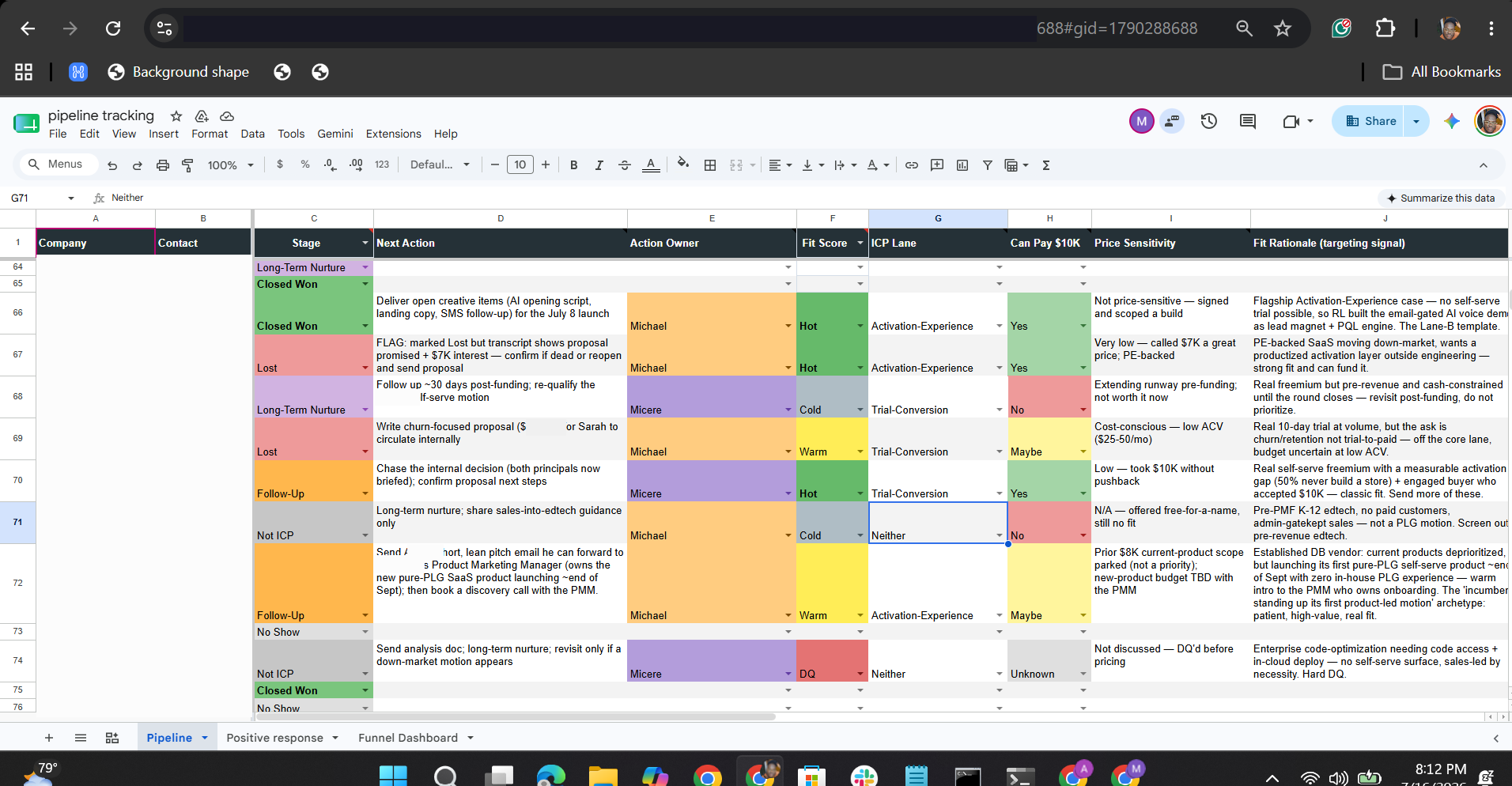
Pipeline tracker with stage, fit score, ICP lane, ability to pay and targeting rationale per account
Every account carries its reasoning. Stage, fit score, ICP lane, whether they can pay at the target contract size, price sensitivity, and the targeting signal that put them on the list. Three tabs: pipeline, positive responses, funnel dashboard. company and contact columns redacted

The loop closed.

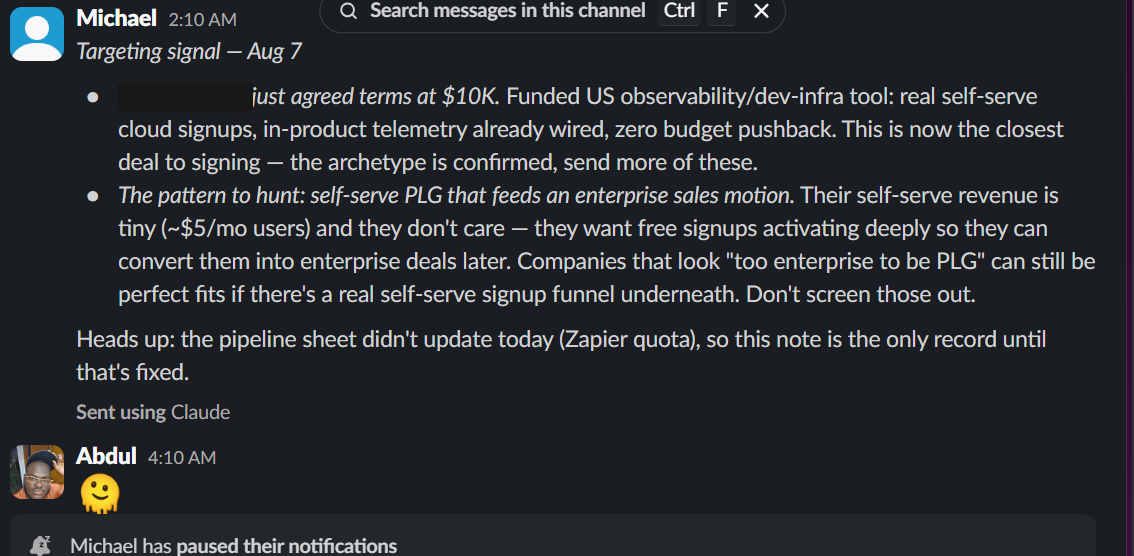
Client message confirming agreed terms at $10K and refining the targeting archetype
Terms agreed at $10K, and in the same message the client refining the archetype to hunt next. That is the feedback loop working: the calls teach the campaign what to send more of. prospect redacted

"The archetype is confirmed, send more of these."

— the client, after a deal agreed at $10K

Fit

Who I don't work with.

Being specific about the no is the only way the yes means anything.

Not a fit

MarTech selling to someone other than brands

If your buyer is a bank, a hospital or a government department, none of my market knowledge transfers and you should hire someone who has it.

Not a fit

An offer that is not settled yet

If what you sell is still moving, more email will not help. A sales motion cannot settle while the thing being sold keeps changing. I will say so on the first call rather than three months in.

Not a fit

Nobody to take the calls

Booking meetings into a calendar with no one behind it wastes your money and my work. I will ask about your capacity before committing to volume.

Worth asking about

Niche exclusivity

I work on contract, which means I choose the verticals I take. If it matters that I am not running the same system for your closest competitor, that is negotiable. Raise it early.

Free, and specific

Send me your offer. I will send back the plan I would run for it.

Give me your website and what you sell. Within 24 hours you get a written GTM plan for that one offer, built the same way I build one for a client who is paying me.

Not an audit, and not a page of best practices. A plan with real company names in it.

The segment worth your money

Which slice of ecommerce and consumer brands actually fits this offer, and the evidence I would qualify them on. A filter you can run, not a persona.

Where the list comes from

The source I would pull it from and roughly how many companies are reachable there right now, so the plan has a ceiling you can see before you fund it.

The angle, per segment

What the first line opens on for each group, and why that one instead of the obvious one.

One real email

Written to a real company off that list, named, built on a specific data point about them. You judge the copy on an actual example rather than on my description of it.

The arithmetic

What reply rate it takes to reach the meeting number you want, at your list size. You can tell from that one page whether the channel is worth funding at all.

Why it costs nothing. Reading how I think about your market is faster than me claiming I understand it, and if I have your buyer wrong you will see it on the first page having spent nothing to find out. I take three of these a week, which is how the 24 hours stays true.

No call required to receive it. Your details go nowhere else, and I do not sell lists.

Contact

Tell me who you are trying to reach.

Send me the shape of your buyer and I will tell you honestly whether I can help. If I cannot, I will say that too. Or put thirty minutes in the calendar below and we can do it live.

Abdul Warith Salman
Abdul Warith Salman GTM engineer. You deal with me, not an account manager.
abdul@warithsalman.com